Saturday, January 9, 2021

"I JUst ca..n'...t....

When I compare my January 2021 self with myself one year ago, I am amazed at the changes.  I no longer get up and "go to work".  I have become lazy about cooking, and graze throughout the day on whatever is in the cupboard. I also snack on news constantly by checking alerts on my phone. I no longer feel the need to get dressed in the morning before 10 am, and Happy Hour comes earlier and more often. My exercise routine is haphazard at best, despite having close access to a private gym, pool and track. I simply have given up, or gotten out of the habit of doing so much that I did one year ago. Everything has changed due to COVID restrictions, but can we blame the pandemic for everything?  

Recently I was asked to write a book review for the school counselor, who forwarded it to our principal, who included it in her faculty newsletter, which asked teachers to pass it on to their students.  A year ago I would have read the book directly to groups of students sitting at my feet. 


This process of having so much information shared and reshared until it becomes so disconnected from its original meaning, causes me to feel cut off from reality.  I have been moving down underground, where I exist in some dark basement without windows or natural light. 

My life is controlled by apps: Siri suggests when I should set my alarm; I read the news, answer emails and social media on my phone before rising from bed; Google calendar charts my day's events; I would normally use UBER to go shopping, but I can also WhatsApp my house-help to go for me; I pay via electronic transfer on my banking app; and the delivery app brings my evening meal which I watch while streaming a TV show from another app. Technology has enabled me to live without really living. 

I recently visited London without really going into the city. Christmas was spent indoors with family, and New Year's was on TV.  If you asked me, "How was London?" I would have to pass on news of the virus, Brexit and mayhem that I got from the media. But since it is the same media everyone else saw all over the world, what makes me a good source of information? I would be simply resharing something I read or heard. It is no wonder so many strange ideas get circulated on social media, since we have no idea where they came from and how they have been manipulated or distorted in the process. There are already all sorts of these ideas circulating about the storming of the US Capitol. Some state the whole event was a set up by Democrats to make the president look bad. Can we believe anything anymore?

In an effort to get back in touch with reality, I am attempting to turn over a new leaf in 2021.  I will make every effort to reconnect with nature, people, and the simple pleasures of cooking and other hobbies. What is the weather like outside? Maybe I could go outside and see.  Need some information? How about asking a living person instead of messaging a group.  Hungry for comfort food? This means it is time to go shopping for ingredients and experience the pleasure of creating a meal again. Feeling tiered with an aching head? Unplug and connect with nature.


Saturday, December 26, 2020

British Christmas Explained


We start our day getting the turkey into the oven, trussed and stuffed.  Fortunately we no longer attempt to do this at 6 am; health and safety no longer approves of those long roast times at low temperatures. I cannot talk my family out of stuffing the bird, so the chestnut mixture goes in and my mother goes in search of her thimble.  This particular bird proves a tough one to stitch and we go through 3 needles in the process. One was still unaccounted for when the bird went in the oven, so we might find a sharp surprise when carving!   Henry Vlll is credited in starting the tradition of roasting a big bird on Christmas day, although it may have been roast peacock. It has been nothing but turkey ever since.  

Another food you are sure to find on the Christmas day table is Brussel sprouts. These, along with parsnips, have become such a symbol of Christmas in Britain, that it is hard for me to imagine a seasonal feast without them.  I don't know of any other country that embraces these vegetables, many find them unpalatable. No one knows the reason for their introduction, but they do promise to be the one really healthy item on the menu.  As all our other favorite side dishes become frozen foods, the Brussel sprouts will always be fresh and green.  

The most misunderstood Christmas dish is the Christmas pudding, followed closely by the Christmas cake and mincemeat pies.  You must understand that the roots of these traditional sweets are actually in medieval sausages.  Fat, fruit and spices were used to preserve meat that was stuffed into animal intestines. Later dried fruit was used, leading to the name "plum" pudding, which was served without the sausage casings.  The pudding, as well as minced-meat, no longer contains meat, but the spices, fruit and suet remain the same.  If you are not British you have either never tasted this seasonal treat, or wondered how it has endured as a favorite.  For me it encapsulates the British tradition of Christmas. There is a real need to adhere to something that binds us together and makes us feel British. This doesn't mean that the dishes haven't needed a little embellishing to create the enduring appeal, especially for children. Coins are hidden in the puddings which are soaked in brandy and lit on fire: great PR! And if that isn't enough, the pudding is served smothered in a hot buttery brandy or rum sauce. As a child I was given the nonalcoholic sauce, but, like eggnog, I have graduated to the adult version since. The last clever ploy to give prominence to the 'figgy pudding' is to ensure it doesn't share the limelight with any other Christmas treat.  It doesn't have to compete with gingerbread, cookies, or chocolates: there is only one desert choice on the menu Christmas Day. 
Of course, you realize, Christmas is far from over on December 25th.  Boxing Day is another enigma of the British holiday season, because who needs another day of feasting? Well, Christmas is a Church holiday, while Boxing day is the real holiday for all those who spent the last month baking, shopping and preparing. There is no church service, no deadline and no traditional menu. This year COVID has brought back the true meaning of Boxing day by closing stores and stopping shoppers from spending time at the post Christmas sales. We can spend time unboxing our gifts, clearing away the wrapping paper, and eating left overs.  It is a true day off, a time to relax with a glass of wine, some Christmas cake and cheese. 
Christmas cake is a fruit cake, usually soaked in brandy, that will last for months or years.  There is no hurry to finish it.  We can make turkey soup and settle in.  After all, the twelve days of Christmas meant feasting from December 25th until  January 6th until Oliver Cromwell banned everything, including pudding, in 1647.  However, certain traditions survived, allowing Christmas in jolly old England to deliver enduring delight, if not slightly misunderstood.


Tuesday, December 22, 2020

The Perfect Christmas Storm


No, we are not preparing for a snow storm, but for Brexit.  The UK will sever ties with Europe in, what appears to be,  a way that leaves no room for trade deals to be made before January 1st, 2021.  What does this mean? Well we are starting to find out, as the COVID virus is giving those of us in the UK over Christmas, a sort of a trial run. 

The present government had leaned towards continuing with the opening of businesses, and allowing people to travel for the holidays. Then, in an about turn, Boris Johnson announced a partial closing of all businesses in the southeast and London, and a ban on travel out of the area, for two weeks beginning midnight Saturday, December 19th.  Jon and I arrived in London to the news, and we were one of the few who didn't immediately rush out shopping or to train stations and airports.

Christmas had been cancelled. No one was to be traveling to be with loved ones, stores would close, and all gatherings should be avoided.  The ripple affect was that 40 countries immediately put into place a travel ban for passengers leaving the UK. That meant that airports and airlines were scrambling to refund, rearrange and answer questions about the millions of travel arrangements made by every passenger hoping to get home for Christmas.  We found you could fly into the UK, but then your were marooned, unable to leave.  So that affected flights into the country as well. A friend flew Monday through the UK in transit to Ireland. The flight to Dublin was canceled and the airline had to reroute her through Belfast. Not only flights were cancelled, but ferries as well, cutting off that route to Ireland or the continent.  

France very quickly closed its ports to all trucks trying to cross the channel.  That led to long lines of thousands of trucks en route, with nowhere to go.  Would that affect the shipping of our favorite holiday treats and produce? Good thing we already bought the turkey! But those trucks were trying to make their last delivery before all trading must stop on January 1st. If a no-deal Brexit comes before the border opens, then those loads will be lost.  This led to Scotland's declaring: "The U.K. government has to recognize that we are in the midst of a perfect storm and to risk further disruption and financial damage to businesses in just 10 days’ time is completely unacceptable", and asking for there to be further consideration given to the Brexit deadline.  This is already a Brexit that has been delayed since the referendum in 2016, and further delaying the date might be contentious.  Can the UK afford to delay even more? Can it afford Brexit at all?

Many are blaming the governments slow actions towards both Brexit talks and COVID guidelines. However, the real catalyst to this perfect storm is a new variant of the virus that is 70% more likely to spread than the original strain.  This is what is prompting the economic shut down and transport bans. They are attempting to keep the variant from reaching Europe. "Plague Island" has been used to describe the British Isles. They may be too late. This variant has been detected in other countries: Denmark, South Africa and even Australia. 

Could all of this been avoided? Could the Brexit deadline have been set for another date? Probably. Could the country have kept stricter COVID guidelines since the first wave of infections? Certainly. Could the European Union be on better terms with the UK? Hard to say. One quote from the NY Times: “Little England has always wanted to cut off the continent, they’ve finally achieved it.” (Powell).  But their timing is way off!

Sunday, December 13, 2020

Where's an Uber when you need one?


It is after 6pm, the sun is going down, the bugs are biting, and we are waiting for a driver to come and pick us up.  Since moving to Abuja, and after being released from quarantine, Jon and I rely on Uber drivers to take us out and about. There are other transportation options available, but the Uber app is both convenient and familiar. We are able to connect with a driver, give both our location and destination, and make payments, all electronically. This bypasses the problem of using cash and verbally explaining where we want to go.  The only problem is... there just aren't that many drivers, and during peak hours, we find ourselves waiting quite a while for a ride home.

We could go another route: buy a car or hire a driver.  Other teachers find either quite affordable. However, Jon and I tolerate the Ubers, and here is why.  In the 20 to 30 minutes that we wait for a driver, we watch a whole new world go by! Every time we go out, that wait time turns me into an observer and opens my eyes to what it means to live in Abuja.
Night had already fallen while we waited outside the Bush Bar, unable to distinguish which, of the oncoming headlights, was the car coming for us.  A car slowed down and turned off the main highway. Bad idea! The car fell into one of the deep ruts left by the last rain.  If this was our Uber, then we would need to pull them out first. The men who sit by every entrance, some sort of security, came to the rescue. There is no lack of people on the side of the road.  They are waiting for rides, selling products, and even doing their washing.
Our wait outside the supermarket 4U can be chaotic. Everyone is trying to sell us something.  The ladies carry their avocados and bananas expertly on their heads, while the oranges and tangerines seem to be for only men to sell.  We hear, "Tangerines,.. like honey!"  I noticed they are able to keep the pile in place on the trays by using scotch tape.
The Uber is stuck in traffic, so we wait on the side of the road, except there is no side of the road.  If there is a sidewalk, then that space is full of vendors and parked cars. Some times the police show up, to eat or direct traffic.  They look scary with their machine guns, but I do not feel a sense of alarm.  Everywhere is heavily protected. 

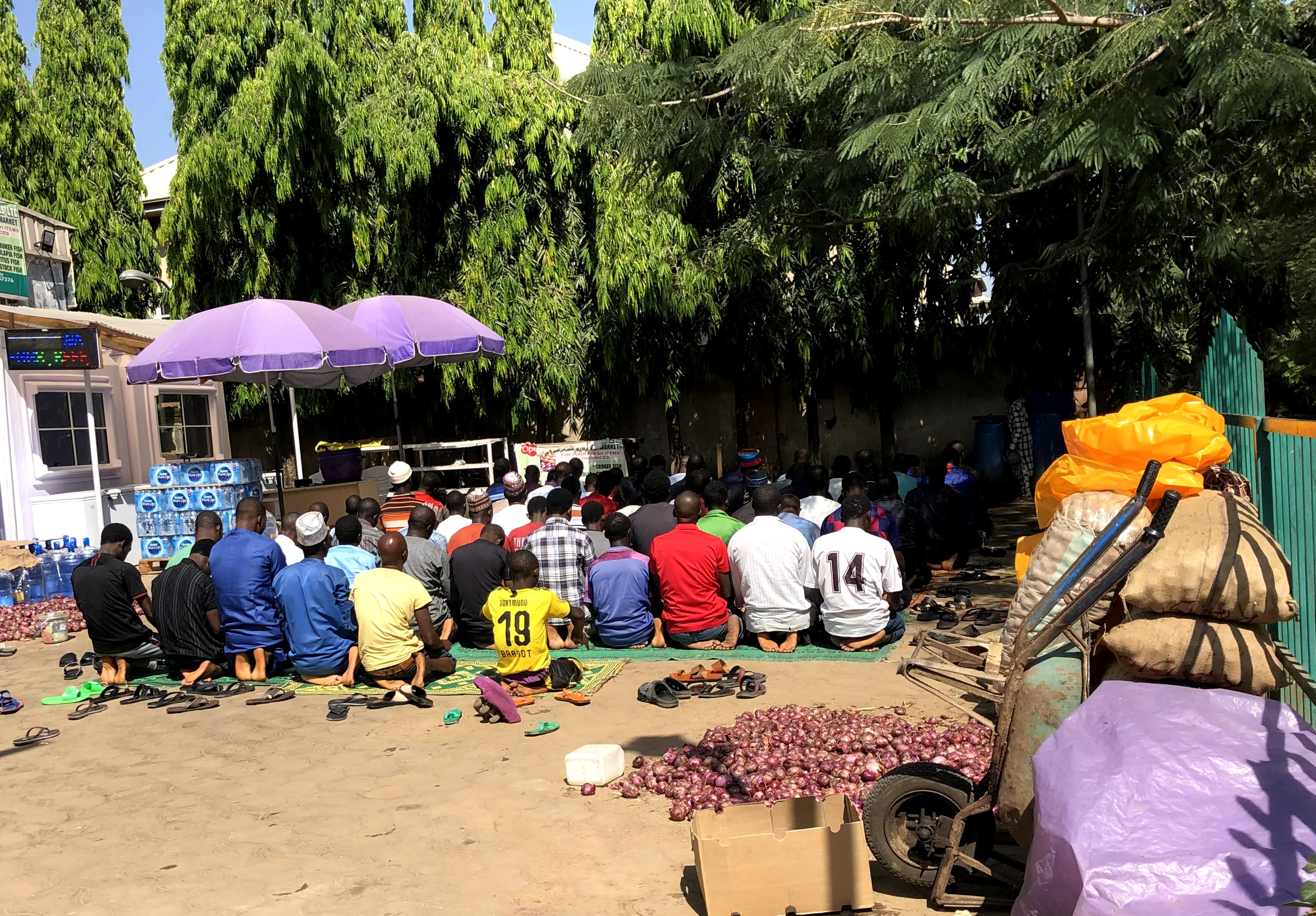
On another hot day, we waited outside the farmer's market with our produce for what seemed to be the only available driver on a Sunday. I wanted to be away from the flies and the dried fish. We were followed across the road by a cripple on wheels, and several women selling buckets of something I didn't recognize.  Although there was a large mosque nearby, prayers were taking place at the edge of the market between the onions spread out to dry.  I noticed men washing themselves by pouring water from small tea kettles. An armed guard approached us, wanting to know what we were up to. Fortunately our Uber arrived the same time and the policeman kindly directed traffic to allow us to get to our ride and on our way.
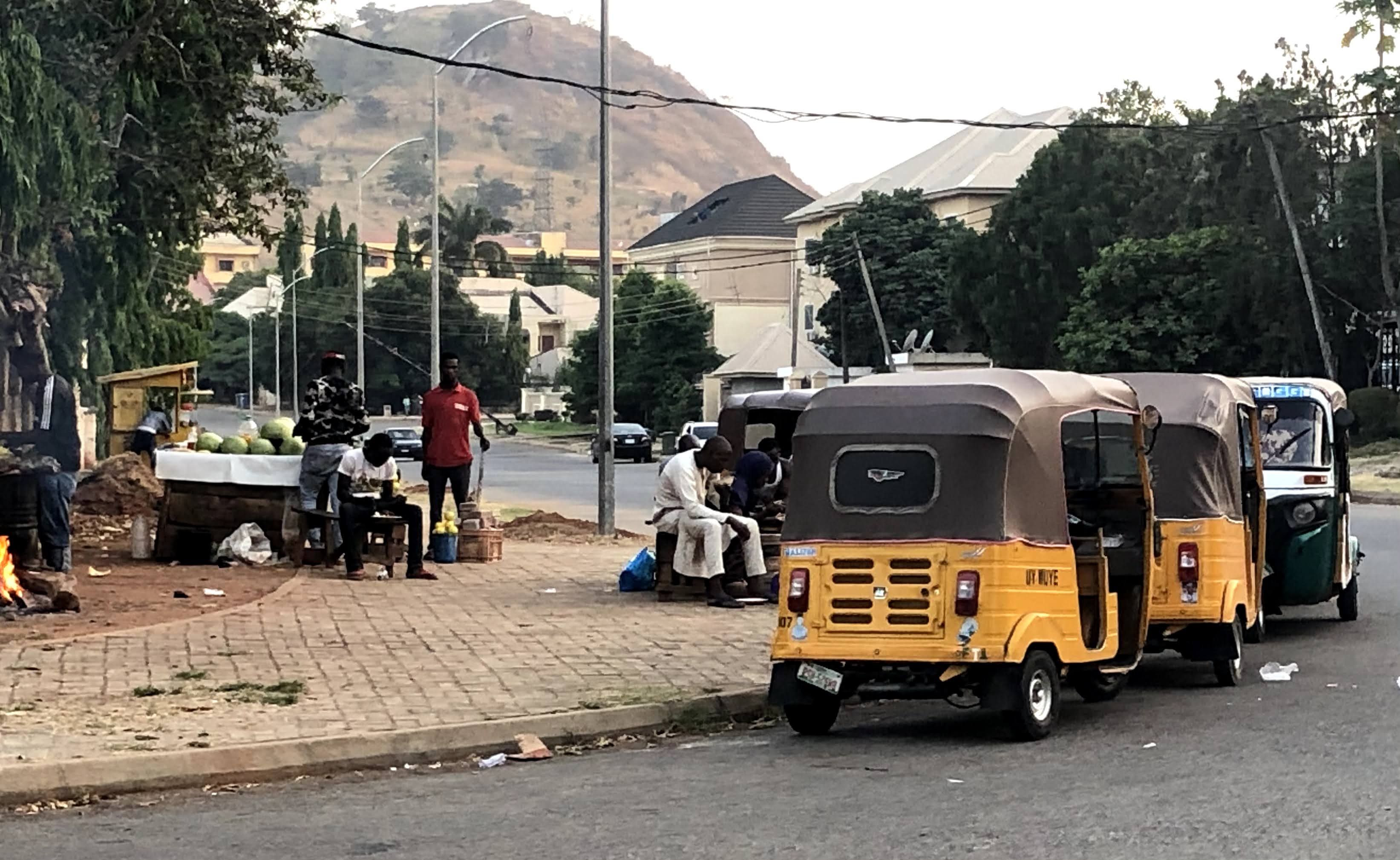
Jon's haircut put us out on the curb, waiting for a ride home, about 6:00pm.  We are realizing that this is a bad time for getting an Uber and, depending on your location, you might just be out of luck.  If all we wanted was a ride, any ride, then we were spoiled for choice.  Every car that passed honked and offered to drive us; and on the corner just opposite was a tuk-tuk stand (known as 'keke' here). As we were pondering the possibility of taking one of these, a man walked by with a sewing machine on his head. Another came by, this time signally with his scissors that he was open for business.  Then another man dropped off a pair of polished shoes to one of the guards at the gate.  He carried his cobbler tools in a box.  Just down the street another man had set up shop and was fixing shoes.  There was a watermelon stand next to the tuk-tuks and other vendors had paused for a rest from carting around their boxes of dates and nuts. An informal barbecue was roasting meat: perhaps the drivers evening meal? Whereas there was plenty of business potential here, I think most of the men had called it a day and were on their way home.  And so were we, Mustafa showed up in a air-conditioned car, and saved us from having to take another form of transport that may or may not have made it to our destination.


Sunday, December 6, 2020

The Cube Cafe


Our Uber driver pulled up to the closed gates of what appeared to be an abandoned amusement park.  We assumed he had the wrong address and asked him to back up past the chickens and overgrown stream bed, to retrace our steps through the upperclass district of Abuja called Maitama. Our destination, the stylish Cube Cafe, must be nearby. 
"Leafy Maitama is an upscale area of grand embassy buildings and chic hotels. Fine eateries offer global cuisine," a description that led us to believe the Cafe would be a popular destination for expats.  Some had described the place as offering live music and a craft fair as well as coffee and smoothies.  The district certainly lived up to its reputation, with wide tree-lined streets and guarded gated communities. However, the empty amusement park seemed out of place. Wandering around, we found Disney style rides, on a much smaller scale, in overgrown grounds. 

The Cube Cafe was tucked away between a memorial to George Floyd and a Beauty and the Beast themed teacups ride.  Inside the quiet atmosphere, the coffee shop offered an inviting menu and seating options.  I ordered a smoothie and perused the books on offer. Other than the fact that there were African patterns on the seat covers, we could have been in any tourist destination around the world. 
The only activity outside, in the park, was a very loud church service: lots of singing and "Alleluias" over the loud speaker. About 1:00pm the meeting broke up, (how long was the service, I wonder?) and the congregation made their way across the park of merry-go-rounds and pirate ships, in their Sunday best. Certainly not an expat crowd.

We followed the crowd out of the park, past the chickens and up the street lined with palms and bougainvillea. We stopped briefly at a farmer's market to buy some bananas and papayas.  A large group of men were in the middle of prayer, kneeling amongst the onions and potatoes, after using tea kettles for washing. Nigeria is roughly half Muslim and half Christian, however, in Abuja, the majority are Muslims.  
This got me thinking about the mixture of cultures that exist in the country.  Yoruba, Hausa, Igbo, Fulani, Ogani, Tiv, Nupe, Kanuri, Ijaw and Annang are just some of the tribes here, and with over 520 languages spoken, there is no wonder that there is a need for English as an official language. 
"Nigeria is a nation of people who eat beef and chicken and cow skin and intestines and dried fish in a single bowl of soup, and it is called assorted, and so get over yourselves and realize that the way of life here is just that, assorted." Nigerian author Chimamanda Adichie in her novel, Americanah (2013 Knopf)


Thursday, November 26, 2020

Expat Thanksgiving


The Turkey Trot has been run, and the club house is being readied for an a Thanksgiving feast put on by the AISA faculty.  This is a unique event, mainly because we all live on the closed campus of the American International school in Abuja, Nigeria.  Although we met just a few months ago, we are accustomed to collaborating on events just like this via WhatsApp.  This post, of the turkey being put in to roast, began the today's feed at 9:13 am.  

Roasting a turkey this size that only arrived frozen yesterday is no mean feat.  Most of us are new to Nigeria and lack roasting pans with racks, and basic familiar ingredients like celery or cream of mushroom soup.  In fact the preparations began days ago, with various shopping trips around the city looking for yams.

I was fortunate enough to find some old cans of creamed corn from Thailand.  The rims are rusty but their sell-by date is March of next year. I put out an all-call for a cheese grater and had another member of staff offer to lend me hers within minutes.  I feel like I have been to so many stores, looking for this and that, but still my kitchen cupboards are almost bare. 
 I am attempting to make scalloped corn and green bean casserole for our feast.  Mohammed had green beans for sale from his veggie truck making sales in the parking lot. Making french fried onions as a topper is beyond me, but I am adding some local ham-bits I ordered from a local butcher. I considered buying a whole turkey from Michael, the butcher, but I am still getting used to what various cuts of meat look like here, and was afraid of what "whole turkey' actually meant.  Would it arrive with feathers and head still attached?
At 9:49 am, our HS principal posts a picture of how an Australian prepares a Thanksgiving turkey: "Terry's breast have been throughly massaged and he's now going in the oven."  This prompted the question, "He's got a name?" and the reply, "We've become very attached."
An I've become quite attached to the staff here.  We Zoom together, work together, live together, and now celebrate together. I am thankful for this group that started bonding over the long wait for visas and travel plans to Abuja. We bonded across time zones, nationalities and age groups. There is little to compare to the faculty of an international school.  They hit the ground running, look out for each other, and pool their resources.  Daily I have advice and words of experience shared with me.  The fact that I am a veteran teacher with over 20 years of teaching and living overseas doesn't mean I know where to buy sunscreen in Abuja.  I have great respect for those among us that are making this move with small children.  I had little support when mine were young, but I have a feeling that won't be their experience here. Here we have family.  We may not be able to get together the way families back home do, because of the measures put in place to prevent the spread of COVID, but we manage to support each other digitally.
It is nearly time to Google the Celsius equivalent for 375 ° F, put my faux green bean casserole in the oven and head down for cocktail hour at the club house.  We plan to eat outside and share each other's recipes from home.


Sunday, November 15, 2020

Mama Africa Market Day


I was excited to visit what I believed to be an arts and craft market to get a picture of local culture as well as pick up some decorative items for my apartment in Abuja.  I had visions of something similar to the 'hippy fair' in Brasilia where tourist can pick up leather goods, jewelry, and perhaps a capoeira demonstration.  

The Mama Africa Arts and Crafts, or Jabi Art Market, does not exactly cry out to tourists.  One would hardly take the cluster of shabby canvas covered shacks for a place to buy souvenirs. As one reviewer described it: Excellent works of art and craft can be found here at reasonable prices. However, the area is reminiscent of a transit camp and needs intervention of a befitting premises. Recommended to visit. 

We glanced quickly at the wooden furniture, and dove into the 'camp'.  Jon and I have learned not to show too much interest in items early on, or the vendors will make it difficult for us to move on to other stalls. We also new that prices were 'negotiable', and haggling was the norm.  I have never been too good at this sort of bargaining, and so was careful to point out that I was "just looking".  Each vendor tried their best to get us into their stall, but they in no way aggressive, and gave us space.  

Honestly, I couldn't at first see anything I would buy.  I was more interested in the colors and variety, the basket weaving activity, and staying cool.  I finally decided on a couple of key chains (very necessary!), two baskets (more decorative), and a fan (both decorative and necessary).  I was quite proud of myself for getting the price down 1000 NGN on the baskets, but the fan guy was proving to be quite difficult.  

Only when I had given up and walked away, did he concede to my 'best price' of 1500 NGN.  The win was short lived, for as soon as I got back on our bus, the fan guy came after me with his friend.  They circled the bus looking for me, tapped on the window, and explained to anyone who would listen that they needed more money for the fan.  He was selling for his friend, and his friend wanted more.  I was safe inside the bus, money had already changed hands, surely he would give up.  But he was determined, and even acted out a fight scene with the friend, trying to get my attention.  In hindsight, I should have simply offered a bit more money, another dollar probably would have ended it.
Unfortunately, the business of haggling for a price, detracts from the actual value of the crafts.  I would have rather have learned about the origin and process of the varied pieces, about the artists and their culture, about the way these artisans are treated in Abuja. Next time.
Next we visited the Maitama Farmer's Market.  If you aren't distracted by the armed guard, and large chunks of dried mystery meat, then you can take in the huge variety of fruit and vegetables.  Again, I will use the words of another reviewer: This place is really good, the amazingly healthy veggies and fruits and luxurious colours of their skin is totally worth the drive. You will think the foods are plastic cause of how fresh and good they looked. And here, we were warned, there was no haggling! I found my okra, bananas and limes.  Jon was denied his mangoes (out of season) and tomatoes (he tried to haggle the price down).  
Our final purchases came from a small market store, that sold imported items like British biscuits and American cans of creamed corn.  Jon was happy to find a large jar of honey that we purchased from a sales girl squeezed into a corner of the tight space. Only after walking out did we realize that we had paid over $60! On inspecting the receipt we saw that the honey cost over $30.  Naturally, we tried to take the honey back.  Unfortunately the sales girl had already shoved the large amount of cash into a slot in the safe.  So Jon had to wait until someone else bought the honey's price with cash before she could refund him. 
At the end of the day, I realized that the experience had been more about business tactics, prices and money conversions.  It is hard to look past how much you are spending to what you are getting.  Fortunately we didn't venture out alone, but with a group of veteran overseas teachers.  One wise college, spoke from experience about her last move: " I had to put a conscious stop to the constant converting of local currency into  US dollars in my head when I was out and about.  That was the only way I could enjoy myself in my new surroundings."